Ingredient profile
Panax Ginseng and Siberian Ginseng in Glyco Harmony: Two Plants, Medicine Cautions
Panax ginseng and Siberian ginseng (Eleutherococcus senticosus) are two different plants, and both are named in the Glyco Harmony blend. The label prints no amount for either, only one 200 mg total for 22 names. Sources say Panax ginseng might lower blood sugar. We found no source we could open on Siberian ginseng.
Written by the Glyco Harmony label deskUpdated
On the label01
Which ginsengs are in Glyco Harmony?
Two. The Supplement Facts list "Eleutherococcus Senticosus Root Extract" fifth and "Panax Ginseng Aerial Extract" twelfth among the 22 names in the blend.
Eleutherococcus senticosus is often sold as Siberian ginseng, but it is a different plant from Panax ginseng. The Panax entry is also unusual. Aerial means the leaf and stem above ground, not the root that most ginseng products and studies use.
The label prints no amount for either one. Fifth place means it is heavier than the twelfth by label order, nothing more. Both sit inside one 200 mg total shared by 22 names.
| Name on the label | Eleutherococcus Senticosus Root Extract |
|---|---|
| What it is | Root of 'Siberian ginseng', a different plant from Panax ginseng |
| Place on the panel | Name 5 of 22 inside the blend (heaviest first) |
| Amount per 1 ml serving | Inside the 200 mg blend; no amount of its own is printed |
| Amount used in research | No source we could open on this plant (the ginseng page we read covers Panax) |
| Strength of evidence | None verified here |
| Marketed or traditional use | Traditional tonic |
| Main caution | We found no source we could open on this name; ask a doctor or pharmacist about interactions. |
| Name on the label | Panax Ginseng Aerial Extract |
|---|---|
| What it is | Leaf and stem (aerial parts) of Panax ginseng, not the root |
| Place on the panel | Name 12 of 22 inside the blend (heaviest first) |
| Amount per 1 ml serving | Inside the 200 mg blend; no amount of its own is printed |
| Amount used in research | A 2022 review of 20 studies (1,295 people) found lower fasting glucose; research in people with diabetes is inconclusive and conflicting (root-based ginseng) |
| Strength of evidence | Limited and conflicting for diabetes; the source covers root, this is the aerial part |
| Marketed or traditional use | Traditional tonic |
| Main caution | Might lower blood sugar, so people with diabetes should consult a provider; insomnia is the most common side effect; may interfere with clotting. |
Panax ginseng02
What does research say about Panax ginseng and blood sugar?
It says the picture is unsettled. NCCIH reports that some evidence suggests Asian ginseng might lower blood sugar, so people with diabetes should consult a provider (NCCIH, Asian Ginseng).
A 2022 review of 20 studies with 1,295 people found better fasting glucose. In people with diabetes, though, the research is described as inconclusive and conflicting. NCCIH also says short-term use of recommended amounts appears safe for most people, but long-term safety is questioned.
All of this concerns ginseng root. The label lists the aerial part, and we found no source on that part for blood sugar or safety. The sales page says Panax ginseng improves glucose uptake independent of insulin. We found no opened source that says so, and the NCCIH page calls the diabetes evidence conflicting.
No study has tested Glyco Harmony or this blend. What a study found for root ginseng at its dose does not carry over to a leaf extract of unknown amount.
Siberian ginseng03
Is Siberian ginseng the same as Panax ginseng?
No. Siberian ginseng, or Eleutherococcus senticosus, is a different plant with different compounds, and the NCCIH page we read covers Asian ginseng only.
We found no source we could open on Eleutherococcus. So we cannot report a benefit, a dose, a side effect or an interaction for it, and we will not borrow the Panax findings. The name is on the label with no amount.
That gap is a reason to ask. A pharmacist can check the name against your medicines, including blood thinners and diabetes drugs, where ginseng products are often a concern.
| Panax ginseng aerial extract | Eleutherococcus root extract | |
|---|---|---|
| Label position | 12 of 22 | 5 of 22 |
| Plant part | Leaf and stem | Root |
| Amount printed | Not printed | Not printed |
| Source we could open | Root ginseng only (NCCIH, Asian Ginseng) | None |
Amounts04
How much ginseng is in a dropper of Glyco Harmony?
The label does not say. The whole blend is 200 mg per 1 ml serving, so all 22 names together weigh less than a fifth of a gram.
An even split would give about 9.1 mg per name. That is our arithmetic. The label does not say the split is even, and the order is by weight, so the numbers differ. We found no ginseng dose in the sources we could open to compare against.
The ruler below places the label amounts beside amounts used in research for other names. The point holds for ginseng too: one 200 mg total cannot tell you what any single name contributes.
357 to 1chromium in trials (above 250 mcg) against the 0.7 mcg on the label
- Chromium on the label0.7 mcg (NIH ODS, Chromium)
- Chromium in trialsabove 250 mcg (NIH ODS, Chromium) (Abdollahi 2013, Chromium Meta-analysis)
- Whole blend on the label200 mg for 22 names (FDA, Supplement Labeling Compliance Guide)
- Caffeine, FDA daily figure400 mg a day (FDA, How Much Caffeine Is Too Much)
- Gymnema in trials500 mg or more (Drugs.com, Gymnema)
- Maca in trials1.5 g or more (Shin 2010, Maca Systematic Review)
Log scale: each step is ten times the last. Crimson dots are the label, amber dots are amounts used in research, the dark dot is an official limit.
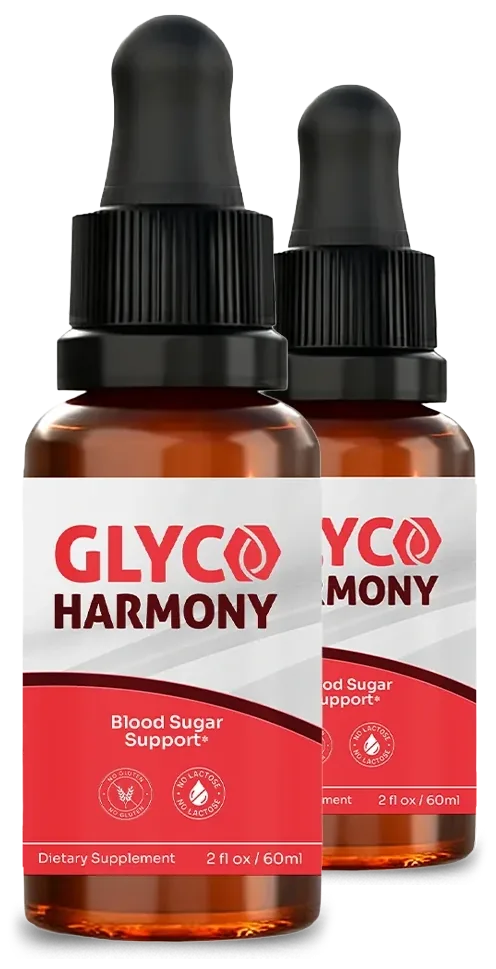
Glyco Harmony: packs of 2, 3 and 6 bottles60 ml dropper bottle · packs of 2, 3 or 6 bottles · price and guarantee terms at checkout
See packsMedicine safety05
Can you take ginseng with diabetes medicine?
Only after asking your doctor or pharmacist. Ginseng might lower blood sugar, and diabetes medicines can already cause low blood sugar (NCCIH, Asian Ginseng) (NIDDK, Low Blood Glucose).
Keep taking prescribed medicine. Never stop, skip or lower it because of a supplement. The label does not say how much ginseng a dropper holds, so the size of the effect is unknown.
Other cautions from NCCIH on Asian ginseng are insomnia, the most common side effect, possible interference with blood clotting and a possible worsening of autoimmune disorders. Rare problems include rash, liver damage and severe allergic reactions. Tell your doctor if you take a blood thinner. Whether the same applies to the aerial part or to Siberian ginseng is not known from the sources we read.
Shaking, sweating, confusion, fainting, chest pain, or yellow skin or eyes need care today. Do not wait to see if it passes.
Before you decide06
What should you ask before using a product with ginseng?
Ask what else you take, what the amounts are and what happens if your readings change.
- Do any of my medicines lower blood sugar, thin the blood or act on the immune system?
- Is the ginseng amount printed? Here it is not.
- Which part of the plant is used: root, leaf, or something else?
- Whom do I call if I feel shaky, sweaty or confused?
A home meter does not diagnose diabetes, so testing belongs with a clinician (ADA, A1C Test). Pregnant or nursing mothers, anyone under 18 and anyone with a known medical condition should consult a physician first, as the label says.
Related reading: supplements and medicines, the proprietary blends guide and the maca page.
FAQ08
Ginseng in Glyco Harmony: questions answered
Is Siberian ginseng a real ginseng?
Not in the botanical sense. Eleutherococcus senticosus is a different plant from Panax ginseng, though it is sold under the Siberian ginseng name. We found no source we could open on it, so we state no benefit or risk for it.
What are the aerial parts of Panax ginseng?
The aerial parts are the leaf and stem that grow above ground. Most ginseng products and studies use the root. We found no source on the aerial part, so root findings may not apply to the label's extract.
Does ginseng lower blood sugar?
It might. NCCIH says some evidence suggests Asian ginseng could lower blood sugar, and a 2022 review found better fasting glucose, but results in people with diabetes are inconclusive and conflicting (NCCIH, Asian Ginseng). Those are root studies, not this product.
Can ginseng cause insomnia?
Yes. NCCIH lists insomnia as the most common side effect of Asian ginseng (NCCIH, Asian Ginseng). The label gives no ginseng amount, and the blend also holds caffeine sources, so take care about timing if you are sensitive.
Should I tell my doctor about ginseng before surgery?
Yes. NCCIH says ginseng may interfere with blood clotting (NCCIH, Asian Ginseng), and general guidance is to tell every provider about all supplements well before an operation (NCCIH, Using Dietary Supplements Wisely). Mention the whole Glyco Harmony label.
Is ginseng safe long term?
Short-term use up to six months in recommended amounts appears safe for most people, but long-term safety is questioned (NCCIH, Asian Ginseng). That covers Asian ginseng root. For the other plant on this label, we found no source.
Sources cited above (10)
- A1C. American Diabetes Association, undated.
- Low Blood Glucose (Hypoglycemia). National Institute of Diabetes and Digestive and Kidney Diseases (NIH), 2021.
- Chromium: Fact Sheet for Health Professionals. NIH Office of Dietary Supplements, 2022.
- Effect of Chromium on Glucose and Lipid Profiles in Patients with Type 2 Diabetes; A Meta-analysis Review of Randomized Trials. Abdollahi M, Farshchi A, Nikfar S, Seyedifar M; Journal of Pharmacy and Pharmaceutical Sciences 16(1):99-114, 2013.
- Gymnema (Natural Product Monograph). Drugs.com medical review staff (no named reviewer), 2026.
- Spilling the Beans: How Much Caffeine Is Too Much?. U.S. Food and Drug Administration, 2024.
- Maca (L. meyenii) for improving sexual function: a systematic review. Shin BC, Lee MS, Yang EJ, Lee HS, Ernst E; BMC Complementary and Alternative Medicine 10:44, 2010.
- Asian Ginseng. National Center for Complementary and Integrative Health (NIH), 2025.
- Small Entity Compliance Guide: Statement of Identity, Nutrition Labeling and Ingredient Labeling of Dietary Supplements. U.S. Food and Drug Administration (CFSAN), 1999.
- Using Dietary Supplements Wisely. National Center for Complementary and Integrative Health (NIH), 2019.
Who wrote this09
Written and reviewed by
Pages built from the label, the sales page and linked NIH, FDA, CDC, FTC and peer-reviewed sources.
Last updated . Read our editorial standards and how we check reviews. This website is the information site of a USA Authorized Glyco Harmony Retailer. It is not the manufacturer or Instituto Experience, the distributor named on the label. We earn money when you buy through our order links.
Keep reading
More about Glyco Harmony
USA Authorized Glyco Harmony Retailer
Ready to try Glyco Harmony?
Check your medicines first, especially insulin or any diabetes medicine, then pick a pack. The checkout shows the price, the shipping and the money-back terms.
- Secure checkout on the sales site
- Money-back terms shown at checkout
- Ships from the U.S.