Guide: reading blends
What Does Proprietary Blend Mean on a Supplement Label?
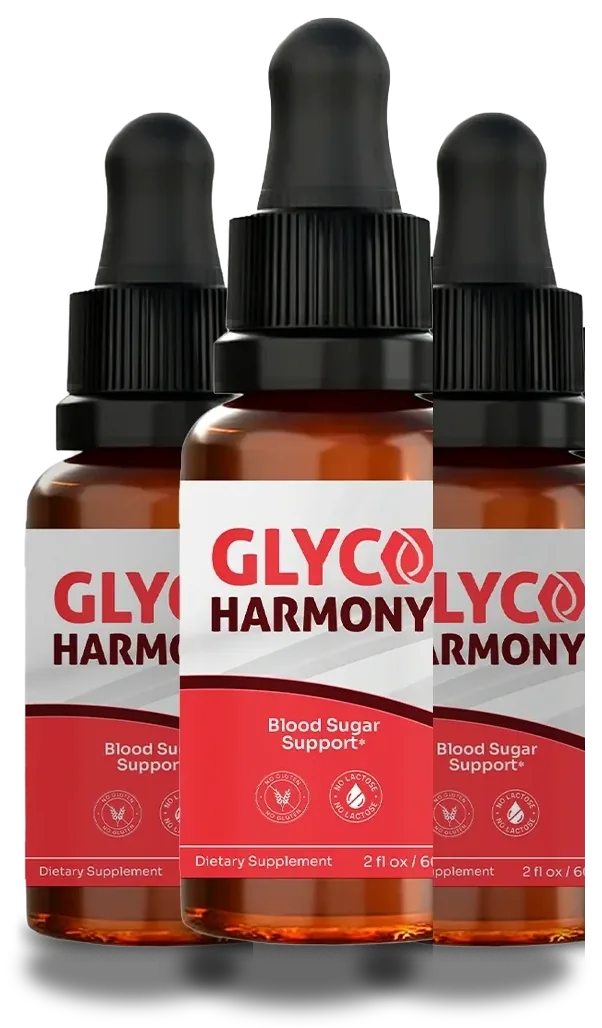
A proprietary blend is a group of supplement ingredients listed under one total weight, with no separate amount for each. US rules let a label show the total and list the names in order of weight. Glyco Harmony shows 200 mg for 22 names, so by our arithmetic an even split would be about 9 mg each.
Written by the Glyco Harmony label deskUpdated
The definition01
What is a proprietary blend?
A proprietary blend is a mix of ingredients that a label lists under a single total weight. The maker names the ingredients but does not say how much of each one is inside.
Some makers use a fancier name for the same thing, such as a complex or a matrix. FDA's labeling guide says the blend must carry the words Proprietary Blend or a descriptive or fanciful name (FDA, Supplement Labeling Compliance Guide).
The word proprietary means the formula belongs to the company. It does not mean the blend is stronger, rarer or better made. It only describes how the label is written.
The rules02
What does the label have to show for a proprietary blend?
It has to show the blend's total weight and list the ingredients in descending order of weight. It does not have to show the weight of each ingredient (FDA, Supplement Labeling Compliance Guide).
That is a permitted format, not a trick, and it is not illegal. The cost falls on the reader. You cannot see how much of any one ingredient you swallow.
| Open label | Proprietary blend | |
|---|---|---|
| Amount per ingredient | Printed for each line | Not printed |
| What you can compare | Each line with a study or a Daily Value | Only the total, and the order of the names |
| Order of names | Any order | Heaviest first, lightest last |
| A very small share | Visible on its own line | Hidden inside the total |
Examples03
What are examples of proprietary blends?
Glyco Harmony is one. Its Supplement Facts panel prints a Proprietary Blend of 200 mg per 1 ml serving, followed by 22 names, and no amount for any of them.
The same panel gives chromium (as chromium picolinate) its own line: 0.7 mcg, which is 2% of the 35 mcg Daily Value. That line shows what an open amount looks like. The 22 names get nothing like it.
A made-up case shows the pattern. Say a label read "Blend X, 300 mg: A, B, C". You would know the three names add up to 300 mg. You would not know whether A is 290 mg and B and C are 5 mg each, or each is 100 mg.
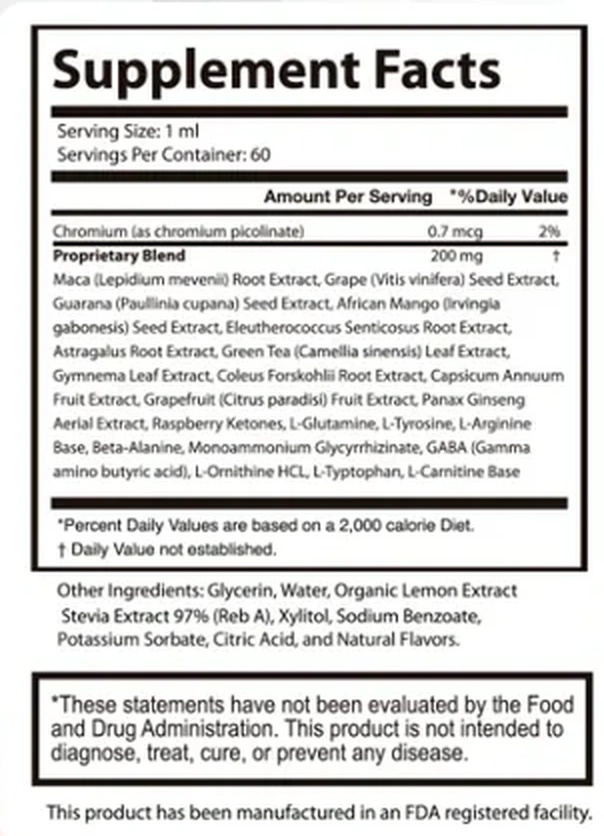
Tap a number to read that part of the label.
- Serving
Serving size 1 ml; 60 servings per container.
- Chromium
Chromium (as chromium picolinate) 0.7 mcg, 2% of the Daily Value.
- Proprietary blend
200 mg for all 22 names together. A blend line does not say how much of each name is inside.
- The 22 names
Maca Root Extract first, L-Carnitine Base last. By label rules, heaviest first.
- Footnotes
Percent Daily Values are based on a 2,000 calorie diet. Daily Value not established for the blend.
- Other ingredients
Glycerin, water, organic lemon extract, stevia extract 97% (Reb A), xylitol, sodium benzoate, potassium sorbate, citric acid, natural flavors.
- FDA statement
These statements have not been evaluated by the Food and Drug Administration.
- Facility line
Manufactured in an FDA registered facility.
The label is typed out on the supplement facts page. The proprietary blend profile covers this blend in detail.
The arithmetic04
How do you do the math on a proprietary blend?
Divide the total by the number of names to get an average, then use the order to bound each name. All the figures below are our arithmetic, assuming the names are in true weight order.
For Glyco Harmony, 200 mg divided by 22 is about 9.1 mg. The first name, maca, must weigh at least that average. The last, L-carnitine, can weigh no more than that average. The label does not say the split is even.
The order also caps every name. The tenth name cannot weigh more than 20 mg, because at least ten names weigh as much as it does and the total is 200 mg. The second, grape seed, cannot top 100 mg.
Now set the average beside research. Trials of gymnema leaf extract used 500 to 1,000 mg a day (Drugs.com, Gymnema), and maca trials used 1.5 to 3.5 g a day (Shin 2010, Maca Systematic Review). Those are tens to hundreds of times the average. A studied dose tells you what was tested, not what works for you.
357 to 1chromium in trials (above 250 mcg) against the 0.7 mcg on the label
- Chromium on the label0.7 mcg (NIH ODS, Chromium)
- Chromium in trialsabove 250 mcg (NIH ODS, Chromium) (Abdollahi 2013, Chromium Meta-analysis)
- Whole blend on the label200 mg for 22 names (FDA, Supplement Labeling Compliance Guide)
- Caffeine, FDA daily figure400 mg a day (FDA, How Much Caffeine Is Too Much)
- Gymnema in trials500 mg or more (Drugs.com, Gymnema)
- Maca in trials1.5 g or more (Shin 2010, Maca Systematic Review)
Log scale: each step is ten times the last. Crimson dots are the label, amber dots are amounts used in research, the dark dot is an official limit.
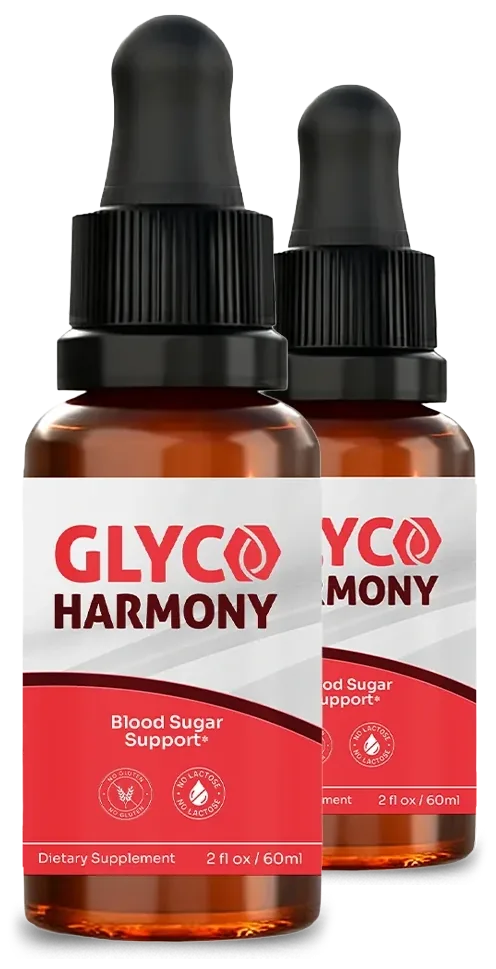
Glyco Harmony: packs of 2, 3 and 6 bottles60 ml dropper bottle · packs of 2, 3 or 6 bottles · price and guarantee terms at checkout
See packsHow to read one05
How can you read any proprietary blend label?
Check five things in order. They work on any blend, from any maker.
Find the total and the count
Divide one by the other for the average share.
Read the order
The first names are the heaviest. The last few are the lightest.
Look for amounts outside the blend
A line with its own number, like chromium here, can be compared with a Daily Value or a study.
Look for caffeine and other actives
A blend can hide a stimulant amount. Glyco Harmony names guarana and green tea extract and prints no caffeine figure (FDA, How Much Caffeine Is Too Much).
Check for outside testing
A USP Verified mark means an independent group tested the finished product (USP, Verification Program). A seller badge does not.
The label comparison guide applies these checks side by side.
Safety06
Is a proprietary blend safe to take?
The format itself is not unsafe. The risk is that you cannot see the amount of any one name, so you cannot check it against a caution.
Several of the 22 names carry cautions in the sources, such as grapefruit with many drugs (FDA, Grapefruit and Medicines). Others have no source we could open. Ask a doctor or pharmacist to look at the whole list.
Keep taking prescribed medicine, and never stop or lower it because of a supplement. Medicines for diabetes can cause low blood sugar, and a supplement that might also lower it adds to the risk (NIDDK, Low Blood Glucose).
Shaking, sweating, confusion, fainting, chest pain, or yellow skin or eyes need care today. See the warning signs guide.
The full list07
What is in the Glyco Harmony blend, by weight order?
The blend lists these 22 names in this order, with maca first and L-carnitine last. The label spells the tryptophan line "L-Typtophan".
- 1Maca root extractno amount printed
- 2Grape seed extractno amount printed
- 3Guarana seed extractno amount printed
- 4African mango seed extractno amount printed
- 5Eleutherococcus senticosus root extractno amount printed
- 6Astragalus root extractno amount printed
- 7Green tea leaf extractno amount printed
- 8Gymnema leaf extractno amount printed
- 9Coleus forskohlii root extractno amount printed
- 10Capsicum annuum fruit extractno amount printed
- 11Grapefruit fruit extractno amount printed
- 12Panax ginseng aerial extractno amount printed
- 13Raspberry ketonesno amount printed
- 14L-glutamineno amount printed
- 15L-tyrosineno amount printed
- 16L-arginine baseno amount printed
- 17Beta-alanineno amount printed
- 18Monoammonium glycyrrhizinateno amount printed
- 19GABA (gamma amino butyric acid)no amount printed
- 20L-ornithine HCLno amount printed
- 21L-tryptophan (printed 'L-Typtophan')no amount printed
- 22L-carnitine baseno amount printed
From the Supplement Facts panel, in label order (heaviest first): one proprietary blend of 200 mg per 1 ml serving. Chromium (as chromium picolinate) has its own line, 0.7 mcg, outside the blend. Other ingredients (glycerin, water, organic lemon extract, stevia extract 97% (reb a), xylitol, sodium benzoate, potassium sorbate, citric acid, natural flavors) are not counted. No name in the blend has an amount of its own; the label does not say how the 200 mg is split.
No study tested a mix of these 22 names. The ingredients page shows each name beside what the sources found.
FAQ08
Proprietary blend questions answered
Why do supplement makers use proprietary blends?
The word proprietary means the formula belongs to the company, and the rules let a label show only a total. We found no source that says why Glyco Harmony chose this format, and the label does not explain.
Are proprietary blends legal?
Yes. FDA's labeling guide lets a label show a blend's total weight and list the ingredients in descending order of weight, with no separate amounts. The format is permitted. It does not prove any ingredient is present at a useful amount.
Does a proprietary blend mean the ingredients are underdosed?
Not necessarily, but you cannot tell. For Glyco Harmony, 200 mg shared by 22 names averages about 9 mg each, while studies of single names used hundreds or thousands of milligrams. The label does not say how the 200 mg is split.
How can you tell which ingredient is the most in a blend?
Read the order. FDA's guide says a blend without individual amounts must list its ingredients in descending order of weight, so the first name is the heaviest. In Glyco Harmony that is maca, and the last is L-carnitine.
Is there a proprietary blend in Glyco Harmony?
Yes. One Proprietary Blend of 200 mg per 1 ml serving holds 22 names. Chromium sits outside it on its own line at 0.7 mcg. The Daily Value for the blend is not established, and no amount is printed for any name.
How do I ask a pharmacist about a blend?
Bring the bottle or a photo of the Supplement Facts panel and your medicine list. Ask whether any name interacts with your medicines. The pharmacist can check each name even when the amounts are hidden.
Sources cited above (9)
- Low Blood Glucose (Hypoglycemia). National Institute of Diabetes and Digestive and Kidney Diseases (NIH), 2021.
- Chromium: Fact Sheet for Health Professionals. NIH Office of Dietary Supplements, 2022.
- Effect of Chromium on Glucose and Lipid Profiles in Patients with Type 2 Diabetes; A Meta-analysis Review of Randomized Trials. Abdollahi M, Farshchi A, Nikfar S, Seyedifar M; Journal of Pharmacy and Pharmaceutical Sciences 16(1):99-114, 2013.
- Gymnema (Natural Product Monograph). Drugs.com medical review staff (no named reviewer), 2026.
- Spilling the Beans: How Much Caffeine Is Too Much?. U.S. Food and Drug Administration, 2024.
- Maca (L. meyenii) for improving sexual function: a systematic review. Shin BC, Lee MS, Yang EJ, Lee HS, Ernst E; BMC Complementary and Alternative Medicine 10:44, 2010.
- Grapefruit Juice and Some Drugs Don't Mix. U.S. Food and Drug Administration, 2021.
- Small Entity Compliance Guide: Statement of Identity, Nutrition Labeling and Ingredient Labeling of Dietary Supplements. U.S. Food and Drug Administration (CFSAN), 1999.
- Dietary Supplements Verification Program. U.S. Pharmacopeia (USP), n.d..
Who wrote this09
Written and reviewed by
Pages built from the label, the sales page and linked NIH, FDA, CDC, FTC and peer-reviewed sources.
Last updated . Read our editorial standards and how we check reviews. This website is the information site of a USA Authorized Glyco Harmony Retailer. It is not the manufacturer or Instituto Experience, the distributor named on the label. We earn money when you buy through our order links.
Keep reading
More about Glyco Harmony
USA Authorized Glyco Harmony Retailer
Ready to try Glyco Harmony?
Check your medicines first, especially insulin or any diabetes medicine, then pick a pack. The checkout shows the price, the shipping and the money-back terms.
- Secure checkout on the sales site
- Money-back terms shown at checkout
- Ships from the U.S.